


Events
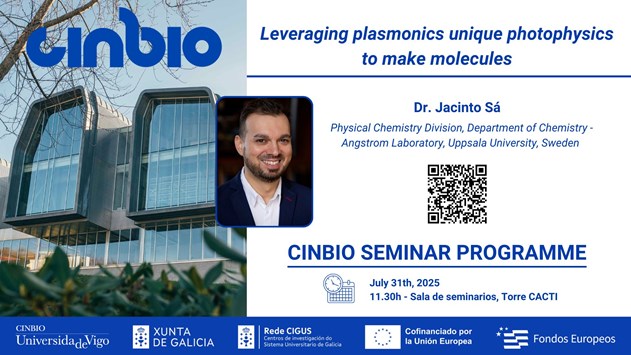
O xoves 31 de xullo o Dr. Jacinto Sá (Physical Chemistry Division, Department of Chemistry - Angstrom Laboratory, Uppsala University, Sweden) ofrecerá o seminario "Leveraging plasmonics unique photophysics to make molecules", dentro do ciclo "CINBIO Seminar Programme".
Será ás 11:30h na Sala de seminarios de Torre CACTI.
ABSTRACT:
Background and motivation. Climate change and increasing global population necessitate sustainable, circular technologies for the production of essential chemicals—from bulk products like ammonia and methanol to pharmaceuticals. Photoredox catalysis has gained prominence for enabling selective, single-electron transformations under mild conditions, a contribution recognized by the 2021 Nobel Prize in Chemistry. However, traditional photoredox systems, typically reliant on molecular photocatalysts, face challenges such as scalability, low quantum yields, high costs, and difficult separation. To address these issues, our research has developed a new class of photosystems based on modified plasmonic materials that overcome the current limitations to industrial implementation.
Results and discussion. We present a process that transforms gold grains into a photoactive platform for photoredox catalysis [1]. These systems are created with minimal waste and are compatible with advanced engineering techniques, operating in a photo-electrochemical configuration to enhance quantum efficiency. This design allows straightforward separation of products from catalysts and supports continuous flow operation, vital for industrial scalability. We used laser-based diagnostics to monitor the behavior of photogenerated charge carriers, providing insights into reaction dynamics [2,3]. The platform efficiently catalyzes challenging radical reactions, such as C–N bond formation, by leveraging the unique photophysical properties of plasmonic materials [4].
BIO:
Jacinto Sá is Professor at Uppsala University. His research group focuses on the development of heterogeneous photo-electro-catalysis based on plasmonics. Building on advanced ultrafast characterization methods, the group is developing unique systems for applications ranging from artificial photosynthesis to photoredox catalysis.


