


News
Spotlight on Ana Covelo
We are proud to kick off our “Women in Science: Shaping the Future of Science” series, featuring Ana Covelo, a researcher in the Neurocircuits group at CINBIO Research Center.
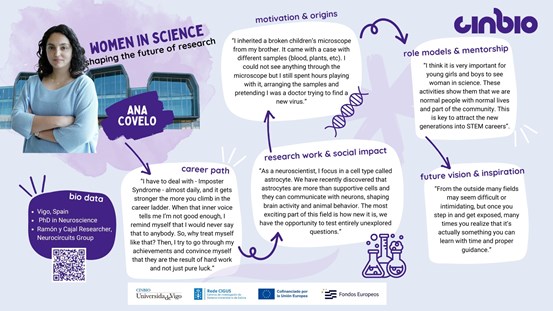
Driven by curiosity and a deep sense of purpose, Ana has built a career dedicated not only to scientific discovery but also to creating a more inclusive research environment. In this profile, she looks back on the experiences that shaped her path, shares her perspective on equality in science, and reflects on the role of mentorship and leadership in fostering new talent. She also explores the real-world impact of her work on neuroscience and her vision for where science is headed.
Get to know Ana’s journey and see how her work is contributing to the future of biomedical research. Her CV is available here.
💡 Would you like to be part of this initiative? Check out the profile questions and share your story with us.
THE ANSWERS:
Career path
Regarding the "gender awakening": Was there a specific moment when you became aware of gender bias in academia? What was the trigger?
During my PhD I had the pleasure to work with and excellent postdoc. Everybody wanted to collaborate with her and my PhD advisor will always go to her to discuss the ongoing projects. She was truly valued in the lab and in the institute. Once, I was discussing a project with some researchers and I suggested we get her involved, given her expertise. However, they decided not to do it because she was pregnant at the time. They said she was not thinking in science anymore, but in her private life. Of course, all those male researches had kids.
Have you ever experienced "Imposter Syndrome"? How do you cope with it?
I have to deal with “Imposter Syndrome” almost daily, and it gets stronger the more you climb in the career ladder. When that inner voice tells me I’m not good enough, I remind myself that I would never say that to anybody. So, why treat myself like that? Then, I try to go through my achievements and convince myself that they are the result of hard work and not just pure luck.
Research work & social impact
What is your current field of study, and what is the most exciting part about it?
As a neuroscientist, I focus in a cell type called astrocyte. We have recently discovered that astrocytes are more than supportive cells and they can communicate with neurons, shaping brain activity and animal behavior. The most exciting part of this field is how new it is, we have the opportunity to test entirely unexplored questions.
How do you handle frustration when an experiment or a grant proposal doesn't go as planned?
I let myself get a little sad and frustrated in the moment. But the next day I try to focus on finding solutions for the experimental design, I revisit the hypothesis or, in the case of grant proposals, I try to think how to make it better for the next call.
Motivation & origins
What drew you to science instead of other disciplines?
I inherited a broken children’s microscope from my brother. It came with a case with different samples (blood, plants, etc). I could not see anything through the microscope but I still spent hours playing with it, arranging the samples and pretending I was a doctor trying to find a new virus.
Role models & mentorship
Do you think the historical lack of female role models in textbooks affected your generation?
The lack of female role models was not the only problem. At university, some professors were trying to give visibility to woman’s achievements, which is great. However, the stories were always followed by how a man had “stolen” the credit or silenced her contribution. This felt very discouraging.
How important is science communication (outreach) in creating new role models for the next generation?
I think it is very important for young girls and boys to see woman in science. These activities show them that we are normal people with normal lives and part of the community. This is key to attract the new generations into STEM careers.
Future vision & inspiration
How would you encourage a young girl who is hesitant to choose a STEM career because it seems "too difficult"?
From the outside many fields may seem difficult or intimidating, but once you step in and get exposed, many times you realize that it’s actually something you can learn with time and proper guidance.
If you weren't a scientist, what other profession do you think you would have pursued?
I feel I would have been good at logistics. I love working with details and making sure things run efficiently.
Is there a specific study or discovery by someone else that made you think: "I wish I had authored that"?
I wish I had discovered mirror cells. These are neurons in the cerebral cortex that activate both when we observe someone else performing and action and when we perform the same action ourselves. In a way, they allow us to “see and copy” others. For instance, when you see someone yawn you also yawn; or if someone smiles to you the natural response is to smile back.


