Events
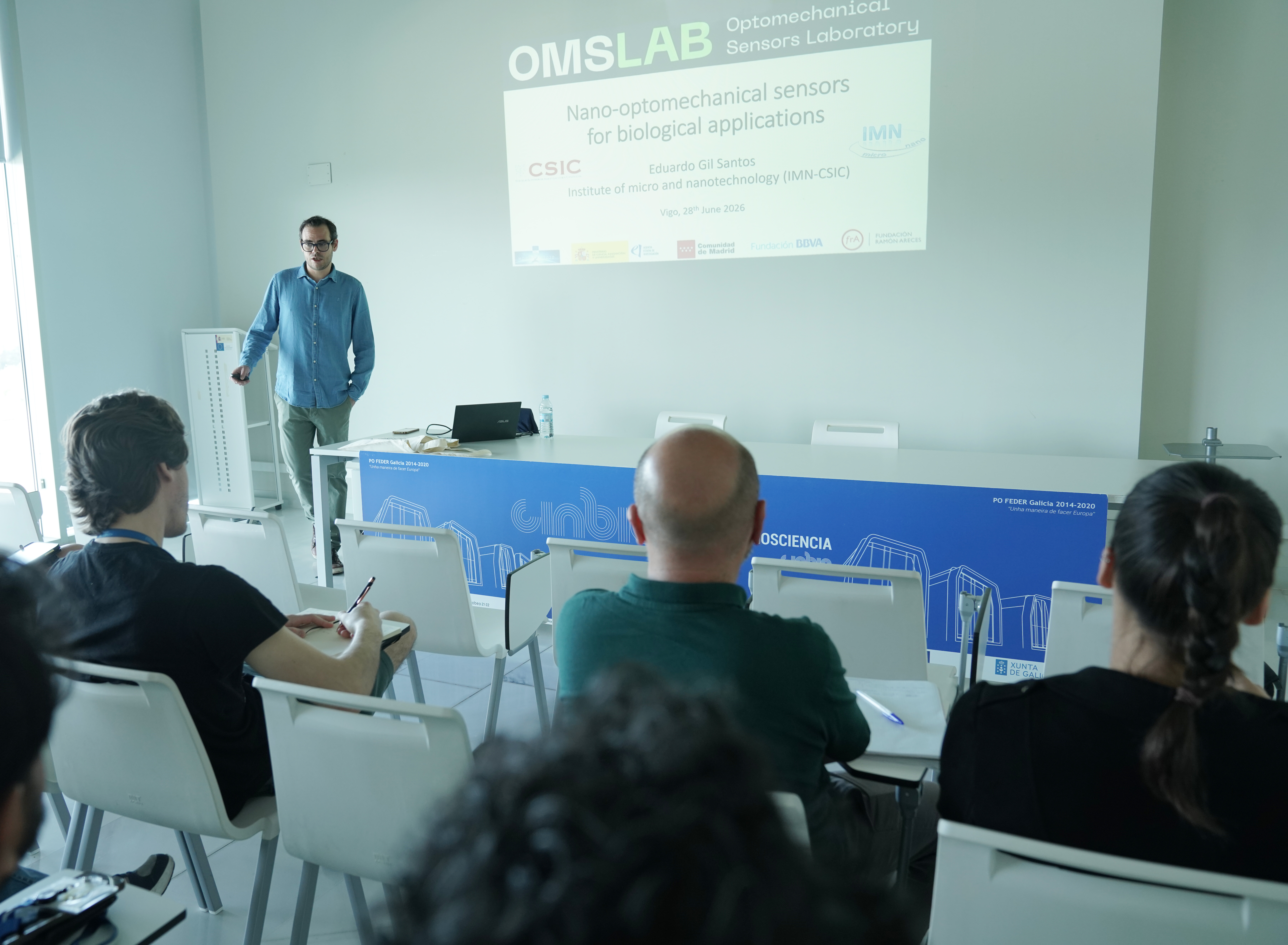
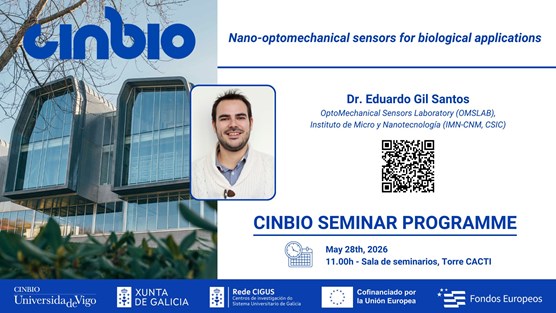
O xoves 28 de maio de 2026, o Dr. Eduardo Gil Santos (OptoMechanical Sensors Laboratory (OMSLAB)
Instituto de Micro y Nanotecnología (IMN-CNM, CSIC) ofrecerá o seminario "Nano-optomechanical sensors for biological applications" dentro do ciclo CINBIO Seminar Programme.
Será ás 11:00 horas na Sala de Seminarios de Torre CACTI.
ABSTRACT:
In recent years, a wide range of optomechanical platforms have emerged as ideal systems for the development of ultrasensitive and ultrafast sensors, enabling diverse applications such as biological and chemical sensing, environmental monitoring, and high-frequency liquid characterization.
Since its establishment, the Optomechanical Sensors Laboratory has focused on pushing these devices to their fundamental limits in order to fully exploit their sensing capabilities, with particular emphasis on biological applications. A few years ago, we demonstrated for the first time the detection of mechanical modes associated with individual bacteria (Figure 1). This was achieved through an innovative approach based on coupling the mechanical modes of the analyte with those of the sensor, in this case a nano-optomechanical disk.
This breakthrough paved the way for the development of a novel technique: mechanical spectroscopy of microbiological entities. Mechanical modes associated with microbiological entities provide highly valuable and precise information about their mechanical and morphological properties. Therefore, this approach holds great promise for the identification of microorganisms, such as bacteria and viruses, through the detection of their characteristic mechanical modes.
In recent years, we have made significant progress toward enabling the detection of multiple mechanical modes from individual analytes, as well as extending this methodology to multiple analytes detection and viral systems.
SHORT BIO:
Eduardo Gil Santos earned his degree in Physics from the University of Santiago de Compostela in 2007. Later that year, he joined the Bionanomechanics Laboratory (CSIC). In 2012, he completed his PhD in Physics at the Autonomous University of Madrid, where he worked on developing innovative devices, concepts, and techniques to enhance the performance of micro- and nanomechanical sensors.
In 2013, he moved to the Laboratory of Quantum Materials and Phenomena at Paris Diderot University (CRNS, France), where he gained expertise in both theoretical and experimental aspects of optomechanical devices and their diverse applications. At the end of 2016, he returned to the Bionanomechanics Laboratory with the goal of applying optomechanical technologies to biological sensing.
Since 2023, he has been a senior scientist at CSIC, leading his own research group, the Optomechanical Sensors Laboratory at the Institute of Micro and Nanotechnology. His work focuses on the development of optomechanical sensors, with a particular emphasis on biological applications, especially for the diagnosis of infectious diseases.
His scientific work includes 38 articles indexed in ISI journals, 1 book chapter, and 6 patents (5 granted and 1 registered). His publications have received a total of 1.993 citations, resulting in an h-index of 22 according to Google Scholar.