


Events
O venres 17 de xullo de 2026 teremos dobre sesión no ciclo CINBIO Seminar Programme. Será a partir das 11:00 horas na Sala de Seminarios de Torre CACTI:
A Dra. Nuria Domínguez-Iturza (Harvard University. Department of Stem Cell and Regenerative Biology Stanley Center, Broad Institute of MIT and Harvard) ofrecerá o seminario "Molecular mechanisms governing myelin diversity in the cerebral cortex".
ABSTRACT:
Myelin is a distinctive feature of the vertebrate central nervous system (CNS). During CNS development, oligodendrocytes (OLs) wrap their membrane around axons to create an insulating, lipid-rich structure called the myelin sheath. While defects in axonal myelination are associated with multiple neurological disorders, including autism spectrum disorders, schizophrenia, and multiple sclerosis, we are only starting to uncover the mechanisms that regulate myelin development, maintenance, and remyelination. Cortical myelination is highly heterogeneous and follows a gradient distribution, with deep-layer projection neurons (PNs) being uniformly extensively myelinated, while upper-layer PNs have more diverse patterns and are more sparsely myelinated. OLs are a heterogenous population of cells with remarkable target specificity in vivo. However, the mechanisms underlying oligodendrocyte target selection are still unknown. Here, we applied single-cell molecular profiling of OLs across different cortical layers and across a postnatal time course to understand layer-specific differences in PN myelination. We found that while all cortical layers have a similar compendium of OL states, mature OLs are preferentially located in deep layers. To investigate if PN subtypes can guide oligodendrocyte maturation and myelination, we generated a predicted ligand-receptor interaction map between PNs subtypes and oligodendrocyte states across cortical layers and time. In vivo testing of candidate modulators of layer-specific myelination identified Fgf18 and Ncam1 as novel myelin-promoting molecules. Our results indicate that neuron-class-associated molecular signals can guide differential myelination across cortical layers.
To further understand the development and diversity of cortical myelination, our ongoing research aims at identifying the molecular signals that guide neuron-specific myelination patterns. This knowledge is fundamental to understanding the development and regeneration of myelin in the mammalian CNS.
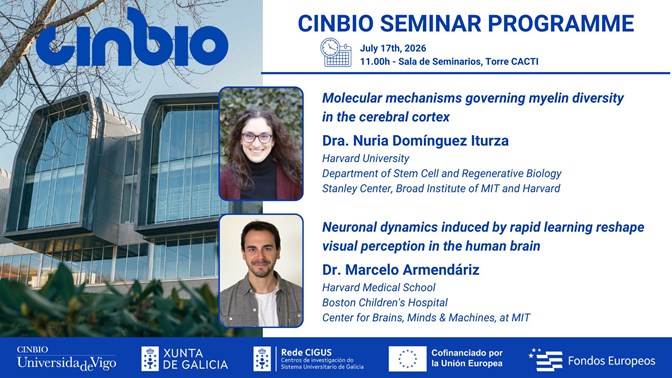
Pola súa banda, o Dr. Marcelo Armendariz (Harvard Medical School. Boston Children's Hospital. Center for Brains, Minds & Machines, at MIT) impartirá o seminario "Neuronal dynamics induced by rapid learning reshape visual perception in the human brain".
ABSTRACT:
Our perception of the world can change dramatically from one moment to the next. A single brief experience can be enough to reshape how we see something, so that what once looked meaningless is suddenly perceived as familiar. For this perceptual change to persist, the brain must form stable neuronal representations to enable future recognition. However, how such rapid perceptual learning is reflected in neuronal dynamics within the human brain remains poorly understood. In this talk, I will present spiking activity recorded from neurons in the occipital visual cortex and the hippocampus of epilepsy patients implanted with electrodes for clinical monitoring, while they performed an image recognition task. The task used a classic trick from vision science: black-and-white two-tone images that look like meaningless blobs until you see the original photo, after which they suddenly snap into a recognizable object. This sudden shift in perception provided an ideal paradigm for studying rapid perceptual learning. I will show how neurons in both the visual cortex and the hippocampus modulate their activity to incorporate rapidly learned visual information and alter future perceptual experience. Notably, neuronal population decoding revealed that visual cortex identified learned images only after additional processing time compared to intact images, with hippocampal responses delayed even further. Rapidly storing memory traces is typically attributed exclusively to the hippocampus, which facilitates neocortical reinstatement via feedback. Challenging this conventional view, our results show that the neocortex can adjust the dynamics of its neuronal populations independently of hippocampal feedback. This study reframes our understanding of the dynamic interplay between neocortical circuits and hippocampal memory systems in supporting rapid learning. Moreover, these findings offer mechanistic constraints for developing biologically plausible computational models of rapid learning from limited experience, highlighting the broader relevance of this work across both biological and artificial learning systems.


