


Events
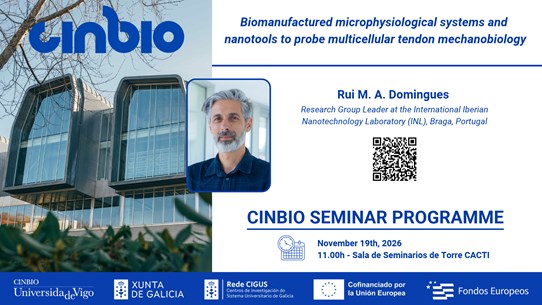
O xoves 19 de novembro de 2026, Rui M. A. Domingues (International Iberian Nanotechnology Laboratory - INL, Braga, Portugal) ofrecerá o seminario "Biomanufactured microphysiological systems and nanotools to probe multicellular tendon mechanobiology" dentro do ciclo CINBIO Seminar Programme.
Será ás 11:00 horas na Sala de Seminarios de Torre CACTI.
ABSTRACT:
Tendons are highly mechanosensitive tissues with complex physiology and limited regenerative capacity, making tendinopathy a major clinical challenge. Their heterogeneous cellular composition interacts within a dynamic extracellular matrix (ECM) whose architecture and biochemical cues are context-dependent. Mechanical forces are transduced through specialized membrane mechanoreceptors, yet the molecular mechanisms driving tendon homeostasis and disease remain poorly understood. A critical bottleneck is the limited availability of representative human in vitro models capable of dissecting these mechanotransduction pathways, particularly those mediated by force sensitive cell receptors.
To address these challenges, this talk will present advanced bioengineering strategies for creating 3D human-based microphysiological systems (MPS) through automated 3D writing within support matrices. This biomanufacturing approach effectively replicates the anisotropic architecture and cellular organization of the intrinsic tendon core. These humanized platforms enable bidirectional crosstalk between tendon core cells and its interfacing extrinsic compartments—including nervous, vascular, and immune components—allowing for the investigation of how complex multicellular communication dictates cell fate under healthy and diseased microenvironments.
Complementing these MPS, we introduce a novel technology utilizing magnetic nanoswitches designed for the wireless, submolecular control of PIEZO1 channels in tendon-relevant cells. These tailor-made nanoactuators are molecularly imprinted to target and actuate PIEZO1 with sub-nanomolar affinity. By wirelessly actuating specific PIEZO1 domains, we can trigger cell mechanotransduction and induce distinct cellular responses, including alterations in downstream gene expression. This capability allows for the dissection of domain-specific roles within the receptor, offering a level of precision previously unattainable for probing cell mechanosignaling.
By integrating 3D-written MPS with these molecularly designed nanoactuators, we aim to provide a powerful framework to unravel the complexities of multicellular tendon mechanobiology. Ultimately, these findings will contribute to the development of nanobiomaterials-enabled, mechanobiology-driven regenerative medicine approaches for tendinopathy.
Acknowledgements: This work was supported by the EU Horizon Europe ERC (Grants No. 772817 and 101171765), FCT project 10.54499/2022.05526.PTDC.
SHORT BIO:
Rui M. A. Domingues is a Research Group Leader at the International Iberian Nanotechnology Laboratory (INL), Portugal, where he leads an interdisciplinary research program at the interface of nanotechnology, biomaterials, biofabrication, and microphysiological systems. Trained as a chemist, he received his PhD in Chemical Engineering from the University of Aveiro, completed postdoctoral research at the University of Minho and The University of Texas at Austin. His research focuses on nanostructured biomaterials and human microphysiological tendon models to study disease mechanisms and develop regenerative strategies. He is an ERC Consolidator Grant recipient (FORTIFy) and actively contributes to the European regenerative medicine community through TERMIS-EU Strategic Alliance Committee and the TENET – Tendon Regeneration Network.


