


Events
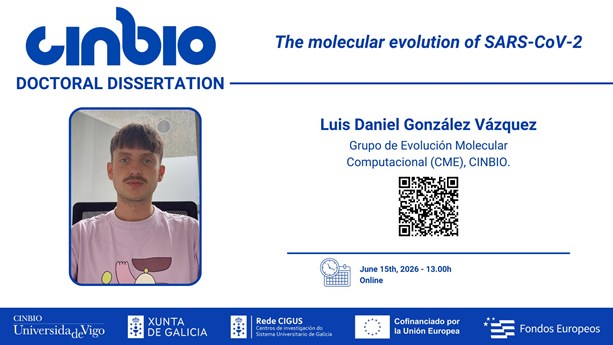
O luns 15 de xuño ás 13:00 horas, Luis Daniel González Vázquez, do grupo de Evolución Molecular Computacional (CME) do CINBIO, defenderá a súa tese de doutoramento baixo o título “The molecular evolution of SARS-CoV-2".
Será online. Datos de conexión:
- Sala virtual 4: https://campusremotouvigo.gal/access/public/meeting/997198883
- Clave de acceso Alumnos para asistentes: XXrrt576
ABSTRACT:
The emergence of SARS-CoV-2 at the end of 2019 triggered an unprecedented global health crisis and generated an extraordinary volume of genomic data, offering a unique opportunity to study viral evolution in real time. However, most genomic surveillance has relied on consensus sequences, which collapse intrahost viral diversity into a single genome and can therefore obscure low-frequency variants, recombination signals, and evolutionary processes occurring below the fixation threshold.
This PhD Thesis investigates the molecular evolution of SARS-CoV-2 across complementary biological scales, from the broader evolutionary history of the Coronaviridae family to the fine-scale dynamics occurring within individual hosts. It first reviews the genomic organization of SARS-CoV-2, the emergence of variants of concern, and the roles of mutation, recombination, and natural selection during the COVID-19 pandemic. Particular attention is given to the heterogeneous evolution of viral genes and variants, showing that evolutionary rates, nucleotide diversity, and signals of molecular adaptation vary across genomic regions and over time, especially in Spike and other functionally relevant regions.
At a broader evolutionary scale, the analysis of the Coronaviridae family shows that recombination and insertion-deletion events are not exceptional features of specific lineages, but recurrent and ancestral mechanisms of coronavirus evolution. Recombination hotspots are concentrated mainly in Spike and ORF1ab, while indels contribute to genome-size plasticity and to the gain and loss of accessory genes, helping explain the structural and functional flexibility observed in coronaviruses.
A central contribution of this work is the development of three bioinformatic tools designed to overcome different methodological limitations in the study of viral evolution. RecSim provides a standardized and reproducible simulation framework to evaluate recombination detection methods under controlled evolutionary scenarios. SRARec extends this methodological contribution to raw sequencing data, detecting intrahost recombination directly from sequencing reads and avoiding the loss of information caused by consensus genomes. Its large-scale application to SARS-CoV-2 and HIV-1 revealed contrasting patterns, with HIV-1 showing a broad genome-wide recombination signal and SARS-CoV-2 displaying a more sparse and focal landscape, with hotspots in regions associated with immune interaction, discontinuous transcription, structural modularity, and replication. Finally, SRASel was developed to track intrahost selection in longitudinal samples from persistent SARS-CoV-2 infections. This approach revealed convergent and parallel evolution in immunocompromised patients, including recurrent changes in Spike, replication-associated proteins, and ORF8, together with localized recombination signals in some cases.
Overall, these results show that SARS-CoV-2 evolution is shaped by heterogeneous mutation, selection, recombination, and indel dynamics, and that raw sequencing data can reveal evolutionary processes hidden by consensus-based approaches. The methodological advances presented here provide higher-resolution tools for viral genomic surveillance, with implications for anticipating future variants and improving antiviral and vaccine strategies.


