


News
Spotlight on Rosana Simón
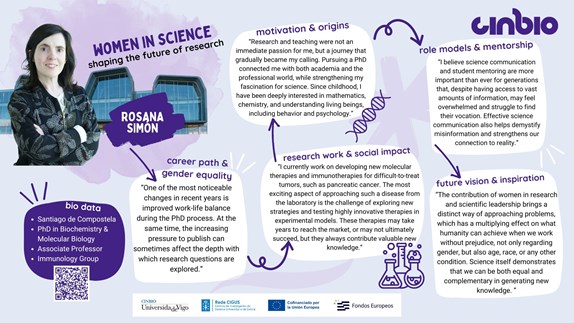
We are happy to launch our “Women in Science: Shaping the Future of Science” series, featuring Rosana Simón Vázquez, a researcher from the Immunology Group at the CINBIO Research Center.
Rosana Simón, a specialist in nanomedicine and new molecular therapies, is an Associate Professor at the University of Vigo and a researcher in the Immunology group at CINBIO. She has extensive experience in nanotoxicology, the development of nanomaterials for the controlled delivery of drugs and proteins, and the characterization of their therapeutic potential.
Get to know Rosana's journey and see how her work is contributing to the future of biomedical research.
💡 Would you like to take part in this initiative? Check out the profile questions and share your own story with us.
Motivation and Origins
“In my case, research — like teaching — was not love at first sight. It was more of a gradual journey that ultimately shaped my destiny in a meaningful way. Choosing to pursue a PhD allowed me to connect with the professional world while remaining close to academia. Those years of doctoral training, combined with my first experiences in university teaching, opened up a new world that truly fascinated me.
That said, since childhood I have felt an almost electric attraction to science. I have always been passionate about mathematics and chemistry, and I was deeply curious about living beings from every possible perspective, including behavior and psychology.”
Research and Social Impact
“I am currently working on developing new molecular therapies and immunotherapies for difficult-to-treat tumors, such as pancreatic cancer. The most exciting aspect of approaching such a disease from the laboratory is the challenge of exploring new strategies and testing highly innovative therapies in experimental models. These therapies may take years to reach the market, or may not ultimately succeed, but they always contribute valuable new knowledge.”
Role Models and Mentorship
“I believe science communication and student mentoring are more important than ever for generations that, despite having access to vast amounts of information, may feel overwhelmed and struggle to find their vocation. Effective science communication also helps demystify misinformation and strengthens our connection to reality.”
Career Path and Gender Equality
“One of the most noticeable changes in recent years is improved work-life balance during the PhD process. At the same time, the increasing pressure to publish can sometimes affect the depth with which research questions are explored.”
Future Vision and Inspiration
“The contribution of women in research and scientific leadership brings a distinct way of approaching problems, which has a multiplying effect on what humanity can achieve when we work without prejudice, not only regarding gender, but also age, race, or any other condition. Science itself demonstrates that we can be both equal and complementary in generating new knowledge.”


