


News
Spotlight on Diana Valverde
We are thrilled to launch the first profile in our “Women in Science: Shaping the Future of Science” series, dedicated to Diana Valverde, a leading researcher in the Rare Diseases group and Deputy Director of the CINBIO Research Center.
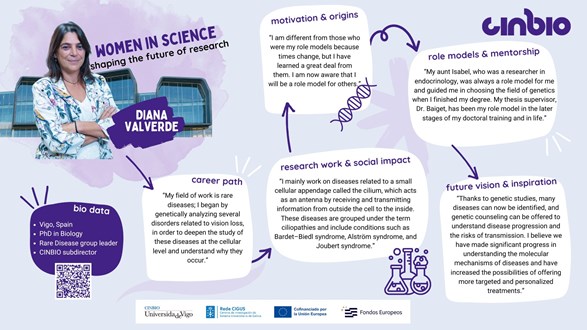
Diana’s journey embodies curiosity, dedication, and a commitment to advancing both science and society. In her profile, she shares insights into her motivation and origins, reflects on her career path and experiences with equality, and discusses her approach to mentorship and leadership. She also highlights the impact of her research on rare diseases and offers her vision for the future of science, inspiring the next generation of researchers.
Dive into Diana’s story and discover how her work and leadership are shaping the future of biomedical research. Check her CV here!
💡 Curious to share your own journey? See the profile questions and join the project.
THE ANSWERS:
Career path
“My field of work is rare diseases; I began by genetically analyzing several disorders related to vision loss, in order to deepen the study of these diseases at the cellular level and understand why they occur.”
Research work & social impact
“I mainly work on diseases related to a small cellular appendage called the cilium, which acts as an antenna by receiving and transmitting information from outside the cell to the inside. These diseases are grouped under the term ciliopathies and include conditions such as Bardet–Biedl syndrome, Alström syndrome, and Joubert syndrome.”
Motivation & origins
“I am different from those who were my role models because times change, but I have learned a great deal from them. I am now aware that I will be a role model for others.”
Role models & mentorship
“My aunt Isabel, who was a researcher in endocrinology, was always a role model for me and guided me in choosing the field of genetics when I finished my degree. My thesis supervisor, Dr. Baiget, has been my role model in the later stages of my doctoral training and in life.”
Future vision & inspiration
“Thanks to genetic studies, many diseases can now be identified, and genetic counseling can be offered to understand disease progression and the risks of transmission. I believe we have made significant progress in understanding the molecular mechanisms of diseases and have increased the possibilities of offering more targeted and personalized treatments.”


