


Events
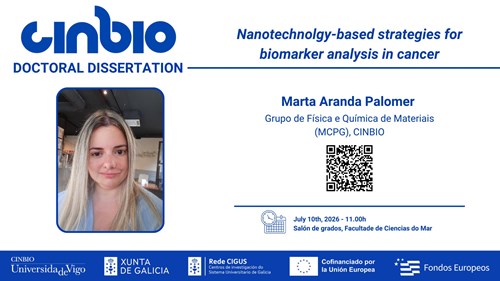
O venres 10 de xullo ás 11 horas, Marta Aranda Palomer, do grupo de Física e Química de Materiais (MCPG), do CINBIO, defenderá a súa tese de doutoramento baixo o título “Nanotechnolgy-based strategies for biomarker analysis in cancer".
Será no Salón de grados, Facultade de Ciencias do Mar.
ABSTRACT:
Cancer remains a premier global healthcare challenge, with metastasis being the primary cause of mortality in highly prevalent malignancies such as prostate and breast cancers. Despite medical advances, current diagnostic methods, including tissue biopsies and clinical imaging, suffer from limitations regarding invasiveness, radiation exposure, and sensitivity. Concurrently, liquid biopsy approaches face diagnostic challenges due to potential false-positive or false-negative results. To address these limitations, nanotechnology and the use of plasmonic nanomaterials, combined with Surface-Enhanced Raman Scattering (SERS) spectroscopy, emerge as powerful and ultrasensitive alternatives for the early detection of extracellular tumor metabolites.
This PhD research focuses on the design, development, and evaluation of nanobiosensors based on gold nanostars (GNS) integrated into biocompatible hybrid hydrogels, optimized for the minimally invasive monitoring of biomarkers associated with prostate and breast cancers. Furthermore, the study incorporates machine learning algorithms for the processing, statistical analysis, and automated classification of the acquired SERS spectra, thereby maximizing diagnostic discrimination and data interpretation.
To establish the analytical framework, the physical principles of SERS, cancer metabolomics, and the application of artificial intelligence in spectroscopy were comprehensively evaluated. Initial experimental phases addressed the Raman analysis of plasma lipoprotein fractions (VLDL, LDL, and HDL) under oxidative conditions, comparing profiles from healthy individuals and oncological patients to evaluate specific lipoprotein metabolic alterations.
Subsequently, hybrid nanobiosensors composed of GNS embedded in gellan gum hydrogels were synthesized and characterized via TEM, UV-Vis-NIR, and Raman spectroscopy. These platforms demonstrated high SERS efficacy in detecting key metabolites such as lactate and glucose in cell lines, utilizing computational models (PCA, LDA, SVM) for automated classification. The translational performance of this GNS-hydrogel platform was further validated through in-vivo and ex-vivo evaluations in biological models, living tissues, and clinical serum specimens collected from prostate cancer patients. Finally, the research explored droplet-based microfluidic platforms for single-cell SERS analysis in breast cancer, optimizing carrier biomaterials (Matrigel, adECM, gellan gum) to enhance cell viability and the identification of tumor-related metabolites like phenylalanine and tryptophan.
In conclusion, the integrated outcomes demonstrate the high potential of the developed SERS platforms and GNS-hydrogel nanobiosensors as advanced, selective, and non-invasive analytical strategies for early diagnosis and personalized medicine in oncology.


