


Eventos
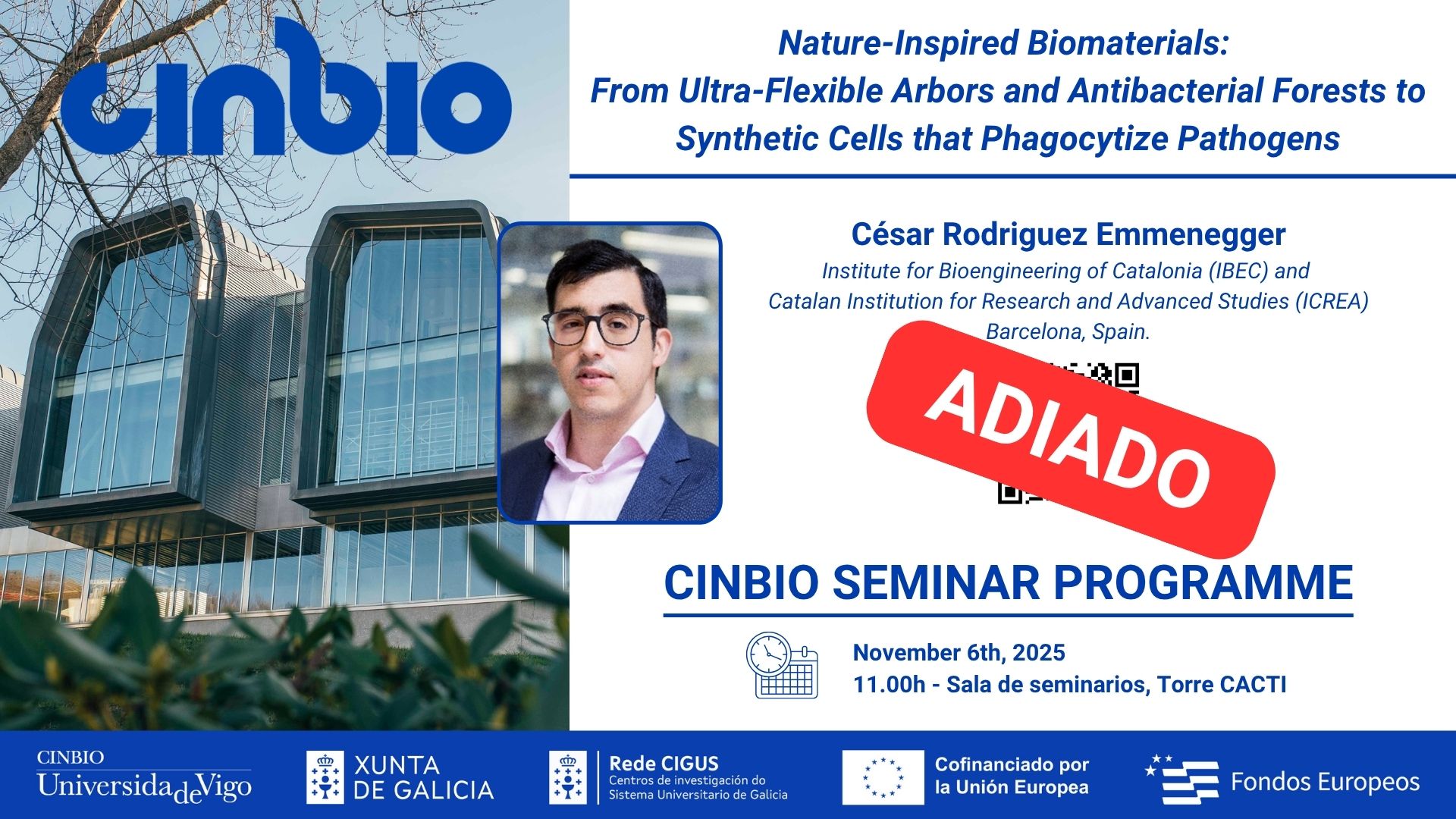
O xoves 6 de novembro, César Rodríguez Emmenegger (Institute for Bioengineering of Catalonia, IBEC) ofrecerá o seminario "Nature-Inspired Biomaterials: From Ultra-Flexible Arbors and Antibacterial Forests to Synthetic Cells that Phagocytize Pathogens", dentro do ciclo "CINBIO Seminar Programme".
Será ás 11:00h na Sala de audiovisuais do CINBIO.
ABSTRACT:
The topology and subtle compositional and sequence heterogeneity of macromolecules play a profound role in encoding information, selectivity, and function—yet these aspects remain underexplored. Here, I will present three classes of macromolecules whose structural design unlocks emergent behaviors.
First, I will introduce hydrophilic arborescent polymers: high-molecular-weight dendritic macromolecules with a regular, multilevel branched topology and a dense periphery of over 500 functional end-groups. Devoid of cross-links or loops, their colloid-to-molecule duality is striking at interfaces, where they spread into one-monomer-thick discs. This adaptable flexibility, coupled with multivalency stemming from the myriads of end-groups, offers potential for designing advanced therapeutics capable of enveloping and inactivating targets.
Next, I will present our strategies to generate antibiofouling nanocoatings, inspired on brushes but readily applicable to medical devices. In particular I will highlight synthetic strategies that can be incorporated in current pipelines and how can we animate these coatings to improve hemocompatibility and antimicrobial capacity.
Finally, I present ionically linked comb polymers (iCPs), synthesized by appending anionic surfactants with lipid-long alkyl tails to cationic residues sparsely distributed on an acrylic hydrophilic backbone. In water, iCPs self-assemble into vesicles —combisomes— featuring membranes consisting of a bilayer of the hydrophobic tails flanked by the hydrophilic backbones tightly adsorbed. This architecture decouples membrane thickness, flexibility and lateral mobility from polymer chain length. Enabling mimicking natural membranes beyond other macromolecular amphiphiles such as block copolymers. Remarkably, combisomes exhibit bactericidal activity through a phagocytosis-like mechanism. Their superpredatory behavior stems from the stochastic topology of iCPs, where some have packing parameters incommensurate with forming bilayers. When forced into one, they act as molecular springs that propel bacterial engulfment, membrane fusion, and effective killing of the pathogen.
These discoveries showcase the power of topological engineering in macromolecular design, opening new avenues for functional materials and bioinspired applications.1
(1) Wagner, A. M.; Quandt, J.; Soder, D.; Garay-Sarmiento, M.; Joseph, A.; Petrovskii, V. S.; Witzdam, L.; Hammoor, T.; Steitz, P.; Haraszti, T.; et al. Ionic Combisomes: A New Class of Biomimetic Vesicles to Fuse with Life. Adv Sci (Weinh) 2022, 9 (17), e2200617. DOI: 10.1002/advs.202200617 From NLM Medline.
SHORT BIO:
César was born in Salto, Uruguay. After studying Chemical Engineering (2001-2006) in the Universidad de la República, Uruguay, he was awarded a research UNESCO-IUPAC internship (2006-2007) in the Institute of Macromolecular Chemistry in Prague where he got hooked in the topic of polymers and biointerfaces. There he pursued his Ph.D. (2007-2012) working on optical biosensors and antifouling surfaces under the mentorship of Eduard Brynda and Aldo Bologna. Following a postdoctoral work (A. von Humboldt postdoctoral fellowship, 2012-2013), and research stays in Melville Laboratory in Cambridge (2009), University of Pennsylvania (2013, 2015), and Pasteur Institute in Lille (2015), César returned to Prague to start his independent group. In January 2016, his group joined DWI-Leibniz Institute for Interactive Materials in Aachen and expanded the research to adaptive interfaces and synthetic cells. Currently, he is an ICREA Research Professor at the Institute of Bioengineering of Catalonia.


