


Eventos
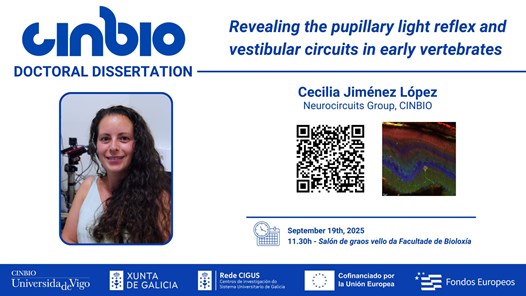
O venres 19 de setembro ás 11:30 horas, Cecilia Jiménez López, do grupo Neurocircuits do CINBIO, defenderá a súa tese de doutoramento baixo o título “Revealing the pupillary light reflex and vestibular circuits in early vertebrates".
Será no Salón de graos vello da Facultade de Bioloxía, no campus de Vigo.
ABSTRACT:
The use of vision for advanced behaviors requires mechanisms that stabilize the surrounding world in the retina to avoid blurry images. This is achieved through the vestibulo-ocular (VOR) and optokinetic (OKR) reflexes that compensate for head movements. Likewise, for the correct functioning of the visual system, the amount of light reaching the retina must be optimized in each environment according to its light conditions. This ocular accommodation is called the pupillary light response (PLR) and consists of changes in the pupil area due to contraction/dilation of the iris muscles. The PLR demonstrated pathways involve autonomic nervous system control and/or intrinsic photosensitivity, although some authors suggest that direct retino-iridal connections may participate in this phenomenon.
The pretectum (PT) is a subcortical area conserved among all vertebrates and placed in the diencephalon that receives direct inputs from the retina. From lampreys (belonging to the group of oldest living vertebrates, the cyclostomes) to humans, the PT is involved in gaze-stabilizing eye movements by sending direct inputs to the ocular motor nuclei to generate the OKR. Likewise, in some vertebrates, the PT also participates in the PLR by sending retinal information to the Edinger Westphal Nucleus, which in turn projects to the ciliary ganglion via the oculomotor nerve (nIII), from where the information is transmitted to the iris muscles.
On the other hand, the VOR appeared early in the evolution of vertebrates and its underlying neural mechanisms are also well preserved from cyclostomes to mammals. The vestibular nuclei (AON, ION and PON), placed in the octavolateral area of the rhombencephalon, receive information from the labyrinth regarding head position and send direct inputs to the ocular motor nuclei to generate the VOR. Nevertheless, a detailed map of the interconnections between the vestibular nuclei and how they interact to achieve the VOR has not been established yet.
Lampreys show a well-developed visual system, with evolutive conserved visual areas. All basic types of eye movements have also been reported in lampreys (OKR, VOR and nystagmus), as well as the same six extraocular muscles present in all vertebrates. The PLR was recently reported in lampreys, although its underlying mechanisms have not been established, and the characterization of the intraocular muscles has not been addressed. Lampreys represent an accessible model to study both vertebrate evolutive aspects and subcortical connections between neural areas, given that its simpler and accessible nervous system allows preparations that are not feasible in classical models.
Taking these advantages, the objectives of this project are to study the mechanisms underlying the PLR and define the brain areas projecting to the vestibular system and the interconnectivity among vestibular nuclei in lampreys. Our results from electrophysiological, anatomical, behavioral and pharmacological experiments performed in brain/eyes/iris ex-vivo preparations confirm that the lamprey PLR is driven by two mechanisms inherent in the eye: an iris intrinsic response and a direct retino-iridal connection. Additionally, we show that elasmobranchs also possess an iris intrinsic PLR mechanism and an ACh-mediated pupillary response, and we further prove that the S. canicula isolated eye can achieve complete closure of the pupil. Altogether, the results indicate that the iris intrinsic PLR is present in all vertebrate groups, and that the retino-iridal PLR mechanism is also likely conserved in other phylogenetically newer vertebrate groups. Regarding the lamprey vestibular nuclei, our data show that they receive projections from rostral brain areas (namely the ventral aspect of the thalamus, the PT and the dorsal isthmic region) and suggest that all vestibular nuclei are interconnected among them, showing a higher communication between contralateral counterparts.


