Eventos
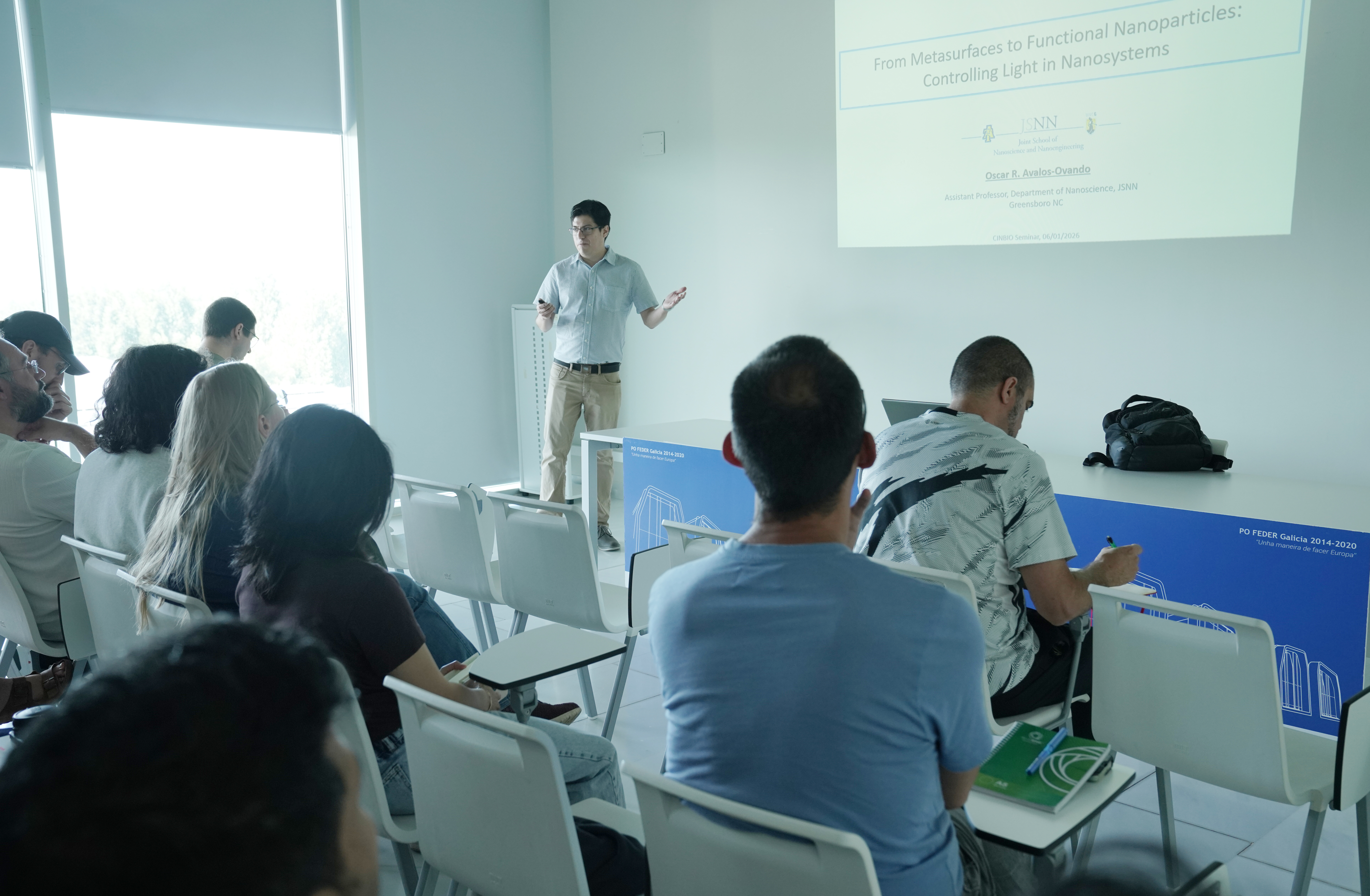
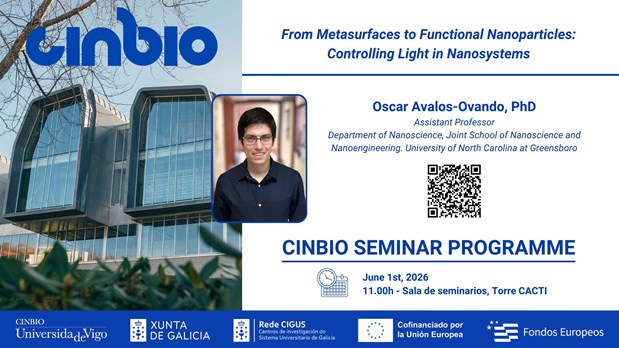
O luns 1 de xuño de 2026, o Dr. Oscar Avalos-Ovando (Assistant Professor, Department of Nanoscience, Joint School of Nanoscience and Nanoengineering. University of North Carolina at Greensboro) ofrecerá o seminario "From Metasurfaces to Functional Nanoparticles: Controlling Light in Nanosystems" dentro do ciclo CINBIO Seminar Programme.
Será ás 11:00 horas na Sala de Seminarios de Torre CACTI.
ABSTRACT:
In this talk I will describe several of our joint theory/experimental studies on electromagnetic properties of diverse nanosystems, such as plasmonic and dielectric nanoparticles. Firstly, I will cover our recent studies about two types of metasurfaces platforms for controlling light confinement: plasmonic gold metastructures which show temporal chirality imprinting, and hexagonal boron nitride metastructures with high Q-factors, which can even increase upon coating. Secondly, I will go over two proposals with nanoparticles for: novel lateral flow assays with alternatives materials such as TiN and Cu@Au nanoparticles, and polarization-dependent photochemistry with chiral gold nanocubes for driving dehalogenation of 8-Bromoadenine.
SHORT BIO:
Oscar Avalos-Ovando is an assistant professor from the Department of Nanoscience, at the Joint School of Nanoscience and Nanoengineering (JSNN), University of North Carolina at Greensboro (UNCG), USA. Dr Avalos-Ovando is a theoretical/computational condensed matter physicist, specialized in diverse simulations of nano-systems such as 2D materials, plasmonic structures, dielectrics, quantum dots, among others. He obtained his PhD in Physics at Ohio University in 2018, after which he was a postdoctoral fellow at Ohio University and Ohio State University. He has co-authored over 40 peer-reviewed publications, co-authored an international patent application, and has been awarded with the 2023 APS FIP-FECS Distinguished Student award, the 2023 APS FECS mini grant, the Ohio University’s NQPI Outstanding dissertation award in 2019, the 2017 APS-FGSA travel award for Excellence in Graduate Research.