


Eventos
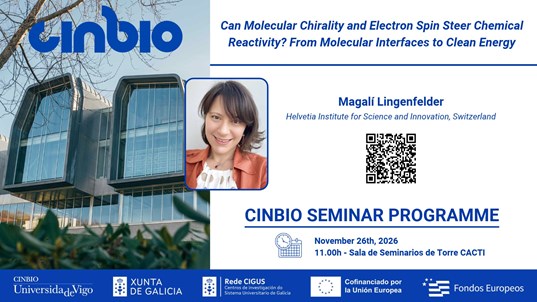
O xoves 26 de novembro de 2026, Magalí Lingenfelder (Helvetia Institute for Science and Innovation, Switzerland) ofrecerá o seminario "Can Molecular Chirality and Electron Spin Steer Chemical Reactivity? From Molecular Interfaces to Clean Energy" dentro do ciclo CINBIO Seminar Programme.
Será ás 11:00 horas na Sala de Seminarios de Torre CACTI.
ABSTRACT:
Chirality is a defining feature of biological molecules and an increasingly powerful tool for designing functional materials. But can molecular handedness do more than control molecular organization and recognition? Could it also influence the spin of electrons and, ultimately, the outcome of chemical reactions? While catalyst design traditionally focuses on composition, structure and electronic properties, electron spin remains a largely unexplored variable for controlling chemical reactivity, with exciting implications for clean energy conversion [1,2].
In this lecture, I will trace our journey from understanding molecular organization at surfaces to observing catalytic interfaces under operating conditions, and ultimately to exploring electron spin as a new tool for electrocatalysis. Our studies of electrically switchable supramolecular networks show how molecular organization at solid–liquid interfaces can be reversibly controlled by external electric fields [3]. Our in situ and operando studies have revealed how catalytic surfaces dynamically restructure during reactions, from CO₂ reduction to oxygen evolution, challenging the conventional picture of static active sites and highlighting the importance of understanding the interface where electron transfer and bond formation take place [4,5].
Building on these insights, we have explored how molecular chirality and magnetic effects can influence catalytic reactions. By exploiting chirality-induced spin selectivity (CISS), we demonstrated that chiral molecular layers can enhance oxygen evolution on earth-abundant two-dimensional catalysts [6]. More recently, we showed that spin-polarized electron transport can promote oxygen reduction even through achiral catalytic layers, providing evidence that spin polarization itself, rather than molecular chirality alone, can influence electrocatalytic activity [7]. Complementary investigations of magnetic fields have revealed how interfacial processes and mass transport can independently affect electrochemical performance, emphasizing the importance of distinguishing genuine spin-dependent effects from other magnetic phenomena [8].
These findings raise a fundamental question: could molecular chirality and electron spin become design parameters for controlling chemical reactions? I will discuss how controlling spin polarization through chiral molecular interfaces and complementary magnetic approaches could open new opportunities for clean-energy electrocatalysis, moving beyond catalytic activity towards the deliberate control of reaction pathways and chemical selectivity [1,2,9]. Ultimately, my vision is to move from observing spin effects to programming chemical reactivity through electron spin.
Selected References
1. Y. Liang, M. Lihter and M. Lingenfelder. Spin-Control in Electrocatalysis for Clean Energy. Isr. J. Chem. 62, e202200052 (2022).
2. B. P. Bloom, M. Lingenfelder, R. Naaman, D. Sun and D. H. Waldeck. Using chiral-induced spin selectivity as a tool to improve materials and processes for energy science. Nat. Rev. Mater. 11, 213–225 (2026).
3. F. P. Cometto et al. Rational Design of 2D Supramolecular Networks Switchable by External Electric Fields. ACS Nano 18, 4287–4296 (2024).
4. T. H. Phan et al. Emergence of Potential-Controlled Cu-Nanocuboids and Graphene-Covered Cu-Nanocuboids under Operando CO₂ Electroreduction. Nano Lett. 21, 2059–2065 (2021).
5. Y. Liang et al. Operando Nanoscale Characterization Reveals Fe Doping of Ni Oxide Enhances Oxygen Evolution Reaction via Fragmentation and Formation of Dual Active Sites. Angew. Chem. Int. Ed. 64, e202419521 (2025).
6. Y. Liang et al. Enhancement of Electrocatalytic Oxygen Evolution by Chiral Molecular Functionalization of Hybrid 2D Electrodes. Nat. Commun. 13, 3356 (2022).
7. P. Vensaus et al. Spin-Polarized Electron Transport Promotes the Oxygen Reduction Reaction. ACS Nano 19, 38709–38715 (2025).
8. P. Vensaus et al. Enhancement of Electrocatalysis through Magnetic Field Effects on Mass Transport. Nat. Commun. 15, 2867 (2024).
9. M. Lingenfelder. A twist away from hydrogen. Nat. Energy 11, 1092–1093 (2026).


