Eventos
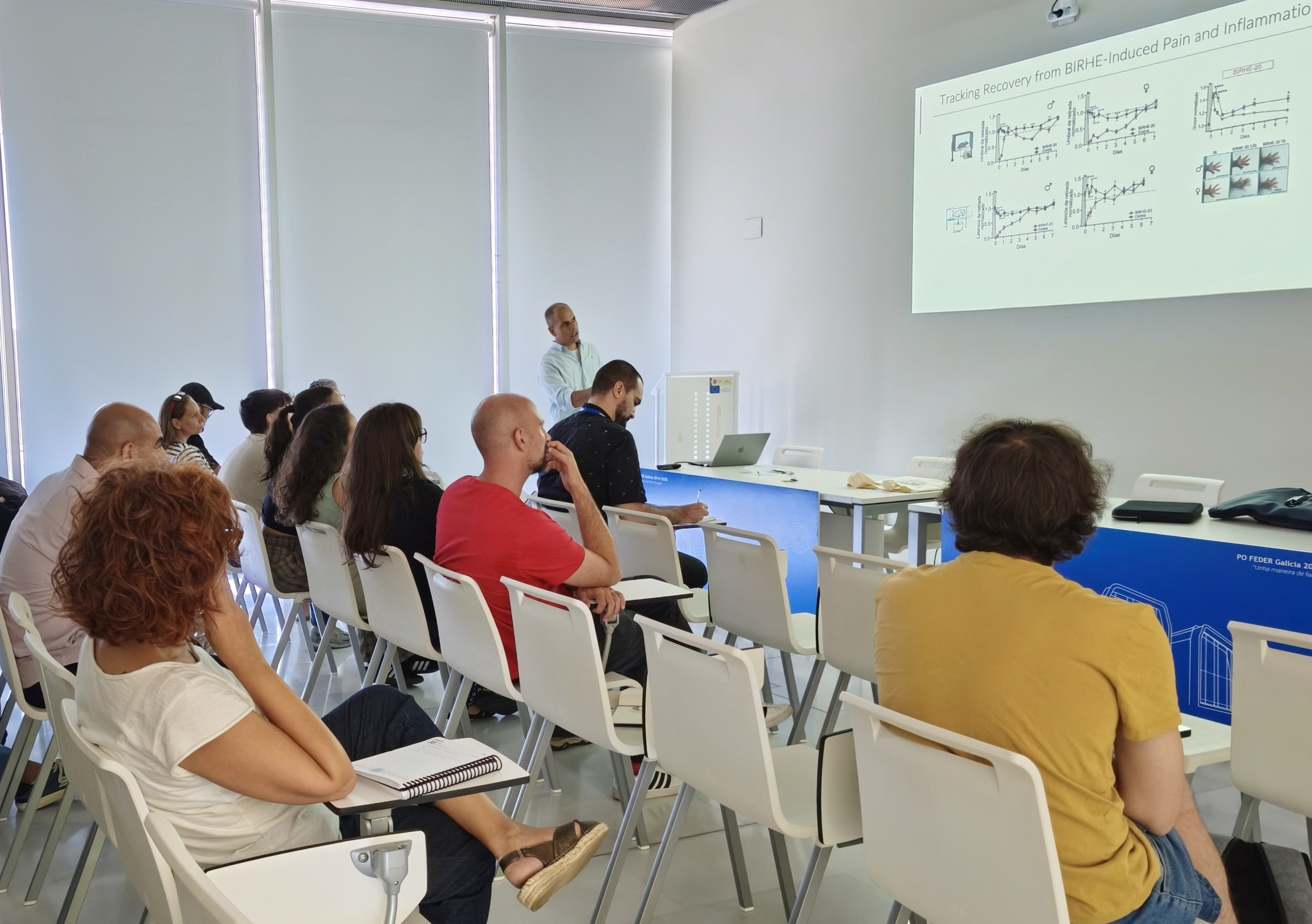
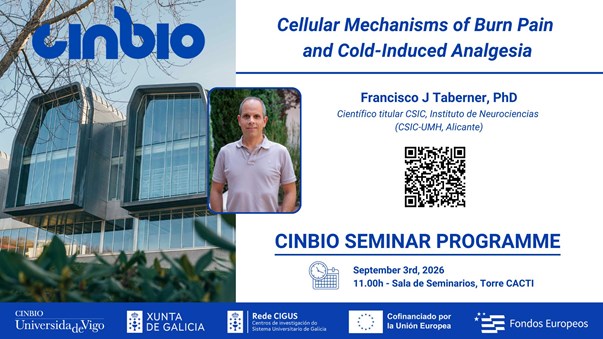
O xoves 3 de setembro de 2026, o Dr. Francisco Taberner (Científico titular CSIC, Instituto de Neurociencias / CSIC-UMH, Alicante) ofrecerá o seminario "Cellular Mechanisms of Burn Pain and Cold-Induced Analgesia" dentro do ciclo CINBIO Seminar Programme.
Será ás 11:00 horas na Sala de Seminarios de Torre CACTI.
SUMMARY:
In this talk, I will discuss our work investigating the cellular and neural circuit mechanisms underlying burn pain and cold-induced analgesia. We developed a novel experimental model to study the peripheral mechanisms of burn pain, the involvement of distinct sensory fiber populations, and the processes underlying pain recovery, revealing important sex-dependent differences. Building on these findings, we investigated spinal circuits involved in burn pain transmission and explored the neural mechanisms underlying cold-induced analgesia. By combining circuit-tracing approaches, single-nucleus sequencing, and behavioral analysis, we identified a key neuronal population involved in the analgesic effects of cold. Together, these studies provide new insights into how burn pain develops and resolves, and how neural circuits can be engaged to suppress pai.
ABSTRACT:
Burn injuries induce a complex and persistent pain state involving profound changes across the peripheral and central nervous systems. In this talk, I will present our work aimed at dissecting the cellular and circuit mechanisms underlying burn pain, its resolution, and cold-induced analgesia.
We first developed a novel experimental model of burn injury that enables the longitudinal study of nociceptive responses, inflammation, sensory nerve endings, and tissue recovery. Using this model, we investigated the peripheral mechanisms underlying burn pain, with a particular focus on the structural and functional changes affecting distinct populations of cutaneous sensory fibers during injury and recovery. These studies revealed marked sex-dependent differences in the evolution of nociceptive sensitivity and in the degeneration and regeneration of sensory nerve endings, highlighting the importance of sex as a biological variable in the mechanisms of burn pain and recovery.
Building on these findings, we moved from the periphery to the spinal cord to investigate the neural circuits involved in the transmission and modulation of burn pain. In parallel, we explored the neural mechanisms underlying cold-induced analgesia by combining neuronal circuit capture, single-nucleus sequencing, and behavioral approaches. This integrative strategy led to the identification of a neuronal population that plays a key role in the analgesic effects of cold.
Together, our findings provide an integrated view of burn pain, spanning peripheral sensory mechanisms, spinal pain circuits, and endogenous pathways of analgesia. They also demonstrate how combining experimental models of injury with circuit-level and molecular approaches can reveal new mechanisms underlying pain and identify potential targets for analgesic intervention.